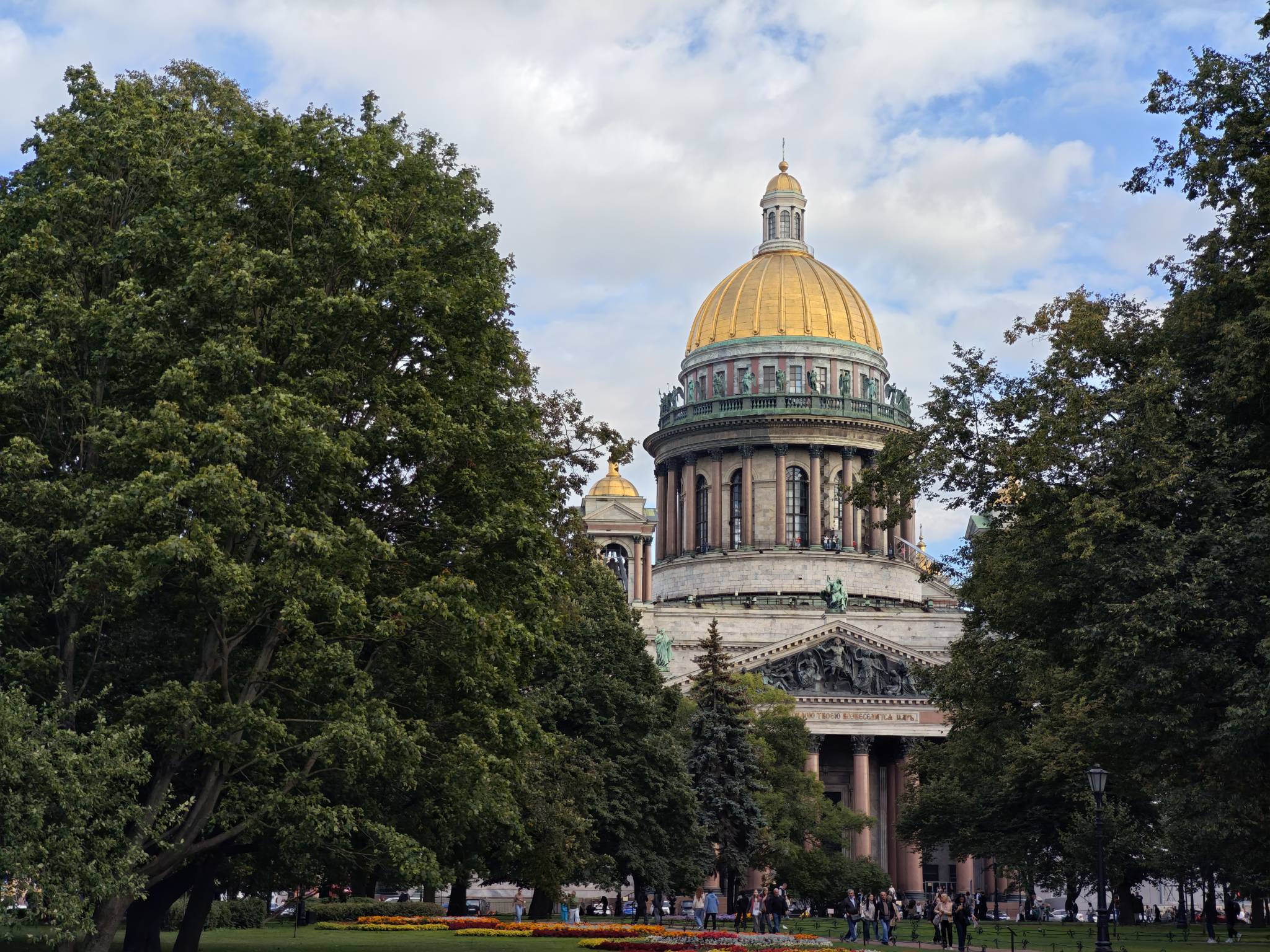
Senate Square
Senate Square lies at the western edge of the Alexander Garden and is one of the most recognisable open spaces in Saint Petersburg. Over nearly three centuries of existence it has changed its name several times — from Isaakievskaya to Decembrists' Square — but has invariably remained a place where the history of state power and the memory of Russia's first armed uprising against autocracy come together.
The formation of the square began as far back as 1704, as part of the glacis of the Admiralty fortress-shipyard — open ground was needed for a field of fire in case of an attack from land. Its southern boundary was for a time marked by a canal used to float ship timber to the yard. In 1710 a wooden Church of St. Isaac was erected on the bank of the Neva, where a few years later Peter the Great was married to his future wife, who went down in history as Empress Catherine I. A stone rebuilding of the church did not stand for long on the marshy bank, and it was here, much later, that Saint Isaac's Cathedral eventually rose, closing off the opposite side of the square; from 1727 a floating crossing operated here across the Neva.
The south-eastern corner was occupied first by the half-timbered palace of Prince Menshikov, and, after his fall from favour, by the mansion of Chancellor Alexei Bestuzhev-Ryumin, built in the Baroque style. When, with the accession of Catherine II, the Governing Senate moved here in 1763 from the Twelve Collegia building, the square came to be known as Senate Square. The unveiling in 1782 of the monument to Peter the Great — the future Bronze Horseman — officially turned it into Petrovskaya Square, yet Petersburgers stubbornly went on calling it by the old name. By 1823 the new Admiralty building completed the eastern side, and in 1834 the Empire-style complex of the Senate and Synod, by the architect Carlo Rossi, appeared, joined by an arch over Galernaya Street.
The square's central event was the uprising of 14 December 1825: about three thousand soldiers, unwilling to swear allegiance to Nicholas I, drew up at the foot of the monument and found themselves surrounded by troops loyal to the government. Pyotr Kakhovsky mortally wounded the governor-general of Petersburg, Count Mikhail Miloradovich, with a shot, after which the mutiny was put down with grapeshot. The centenary of the events was marked in 1925 by renaming the square in honour of the Decembrists, and half a century later, in December 1975, a rare dissident demonstration for those years took place by the monument.
In 1874 the square became part of the new Alexander Garden: flower beds and lawns were laid out around the monument, an alpine rockery was built, and oaks were planted on the side facing the cathedral. Already by 1890 this part of the garden was abolished, restoring the space to the look of a cobblestone-paved square, where a pavilion briefly appeared to offer shelter from the rain. The square's historic name was restored only in 2008, after nearly a century under the name Decembrists' Square.
Today the Constitutional Court of Russia works in the Senate building, and the square remains one of the key points of the ceremonial city centre — a place where imperial statehood and the memory of the first open protest against it stand side by side in a single ensemble.